
College Prep Timeline for Grades 9-12: The Complete Year-by-Year Guide for High School Students
A complete college prep timeline for grades 9-12. Discover what high school students should do each year to build a standout academic profile to get into top universities.
Getting into a top university does not happen overnight. It’s the result of a college prep strategy that starts long before your senior year in school, often as early as the first week of 9th grade. Yet most high school students only start thinking seriously about college admissions in grade 11, but it’s too late to fix a weak transcript or build a meaningful extracurricular profile.
The good news is that college readiness is a skill that you can build one grade at a time. This guide aims to provide you with a grade-by-grade roadmap covering everything starting from course selection, standardised tests to extracurricular activities, research publication and college application process itself, using free tools and expert resources along the way.
Why a 4-Year College Prep Timeline Matters?
Admissions teams at world-class universities aren’t just reading your personal statement, they’re reading the decisions you made in the last 4 years. A strong academic profile shows growth, curiosity and depth built over time, not a last-minute scribbled application. Spreading your college preparation across grade 9 through 12 means you have made a conscious effort to build real expertise through extracurricular involvement, and have genuine stories to talk about in your personal statement.
Our own guide on what top universities actually look for breaks down the factors that admissions officers look for the most, and nearly all of them require multiple years of preparation, which is exactly why timing matters a lot.
Grade 9: Build the Foundation

Ninth grade is all about establishing strong habits that build a strong foundation.
1. Choose a rigorous but sustainable course load.
Colleges want to see you challenging yourself with honors or advanced classes where appropriate, but freshman year GPA still counts toward your cumulative record, so you don’t have to overextend.
2. Develop real study habits.
The habits you build now will carry you through AP exams and beyond. Our blog post on high-impact exam strategies is a useful starting point for you to build a sustainable study routine.
3. Explore extracurricular activities broadly.
Go out of your comfort zone to try a few clubs, sports or creative projects. You need to spread out and gain the exploration first to know where your genuine interest lies.
** 4. Start reading beyond your curriculum.**
Admissions officers look for signs of intellectual curiosity, and it’s not built overnight, it comes through habit. Explore your favourite topics written by multiple authors, and expand your own perspective about the same.
5. Use free tools.
Khan Academy is extremely useful and free for exploring foundational math, science, astronomy, history etc. BigFuture by College Board offers free college and career exploration tools designed for younger students.
Grade 10: Deepen and Specialise
Tenth grade is when your student profile should start taking shape.
1. Narrow your extracurricular activities.
Narrow them down to 2-3 areas where you can build real depth on skills like leadership, initiative and other achievements.
2. Take the Preliminary SAT (PSAT).
It’s low stakes, but gives you an early, honest baseline for standardised test prep, and for some students it may open doors to National Merit recognition.
3. Consider a summer academic programme.
From research internships to intensive subject courses, explore various summer programmes to choose the right fit for your interests. Our round-up of top summer programmes for school students is a good place to compare your options.
4. Start thinking about working on your own research paper.

Research is not just for STEM or university students. It’s for humanities, social sciences and many other fields. If you’re curious about what that path looks like, our research and publication programme pairs students with mentors from world-class institutions like Google, Microsoft, Harvard, MIT, Oxford and Cambridge to guide you through a publishable research work. This will be one of the strongest differentiators in a competitive college applications pool. If you are unsure on why research matters, have a look through how a research publication helps students stand out in Ivy League and Russell Group University applications.
5. Meet with a school/college counselor.
Discuss on how to map your junior year course plan, including AP or IB options.
Grade 11: The Highest-Stakes Year
Junior year carries the most weight in your university applications, since it’s typically the last full year of grades that colleges see before you apply.
1. Take the SAT or ACT
Free official practice is available through Khan Academy’s SAT Prep partnership with College Board and through the ACT Academy, both entirely free.
2. Pursue a capstone project or independent research
By junior year, you should be moving from exploration to execution like publishing a paper, running an experiment, or working on a practical project with actual outcomes. Reading about where young researchers can publish is a next step if you’re building towards publishing your research paper in reputable journals.
3. Take on leadership roles
Take on leadership roles in the activities you narrow down in grade 10. Most colleges want evidence of initiative, not just membership.
4. Start building your college list
Use free tools like BigFuture’s college search or Niche to compare admissions rates, financial aid, and campus culture across a list of your preferred colleges.
5. Begin thinking about letters of recommendation
Identify 2-3 teachers/mentors who know your work well. Junior teachers are usually the ones asked to write letters of recommendation for you.
6. Research scholarship opportunities early
Many merit-based scholarships have eligibility requirements that open in junior year. Our article on how scholarship programmes build academic success covers what selective scholarship committees actually reward.
7. Visit campuses if possible
Try to visit campuses of colleges on your list in-person or virtually, to understand your fit before application processes begin.
Grade 12: Execute the College Application
Senior year is about converting 4 years of preparation into a compelling college application.
1. Finalise your college list
Finalise your most preferred colleges based on reach, courses, placements etc and make sure to know each college’s specific application requirements.
2. Draft your college essay early
The personal statement is where your academic journey becomes a narrative. Start drafting over the summer for a stronger statement before your senior year, so it doesn’t sound rushed or weak. Have a look at our how to write a standout personal statement guide for useful tips.
3. Use the Common Application
Commonapp is a free platform that’s accepted by more than 1,000 colleges to manage most of your university applications in one place. If any target schools require the Coalition Application instead, check them out as well.
4. Request letters of recommendation
Start requesting your letters of recommendation from teachers early in the fall, giving teachers at least 4-6 weeks to prepare them.
5. Submit applications ahead of deadlines
It’s always a better choice to submit your applications ahead of time and not on the deadline. It also gives you enough time to deal with any technical issues and last-minute edits if required.
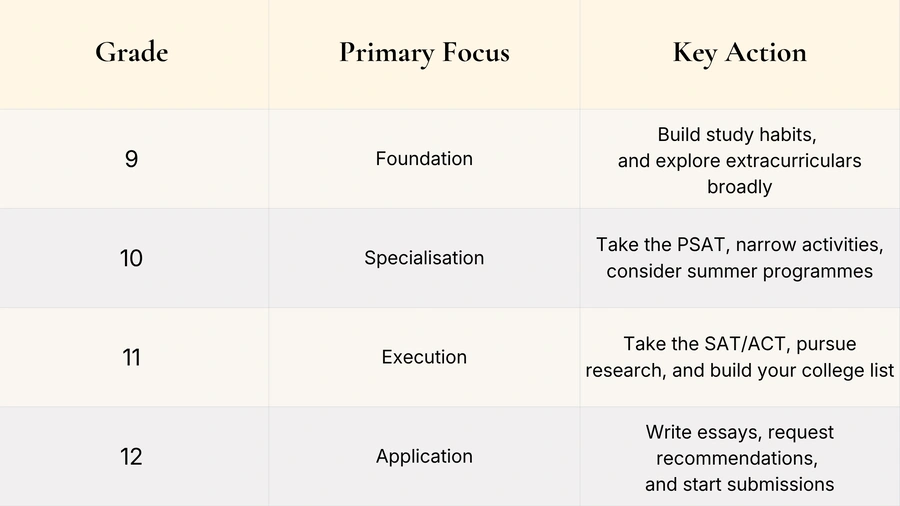
A Quick Overview of College Prep Checklist
Final Thoughts
Students who work through each year of high school as a deliberate step, rather than trying to squish everything into the final year, will build a stronger academic profile that’s more compelling. Start where you are and use the free resources above, take guidance from experts, counselors, and researchers to make the most of the years you have left.
Want personalised guidance for your own college prep timeline? Book a free consultation with Sapiente Education and get matched with a mentor to guide you through building a stronger academic portfolio. You can apply to our programmes directly by visiting our website.