
How to Use AI in College Applications the Right Way (Without Risking Rejection)
Learn how to use AI the right way in your college applications, what admissions teams actually allow, what essays get rejected, and how to keep your voice authentic.
Artificial Intelligence has silently started to become a part of almost every student’s college application process, and the admissions team are definitely aware of this.
A 2026 Pew Research study found that more than half of US teens have used AI chatbots for school assignments, and the number is rising, especially for personal statements and academic essays. The most important question for students and parents in 2026 is how they are planning to use AI without triggering red flags, plagiarism, sounding robotic, or risking rejection.
This guide aims to break down what admissions officers are actually thinking about AI, where we should draw the line, and how to use AI tools smartly, as a thinking partner, so your application still sounds like you.
Why Is This Important?
One thing seems very clear: usage of AI for college essays have risen sharply in 2026. Some universities and schools have taken a hard stance regarding this. Caltech has stated that admission can be rescinded if a student is found to have violated their AI policy.
University of California has begun running plagiarism checks that can disqualify applicants whose essays feel AI-generated and robotic.
At the same time, some other educational institutions have no formal or official written policy on AI-generated essays. The differences between university AI policies are exactly what make this such a confusing moment for applicants, and why being cautious and informed about college admissions AI policy matters so much.
Why Full AI-Generated Essays Are an Ethical Problem (Not Just a Rule)
Beyond the risk of rejection, there is actually a much simpler reason why a fully AI-generated essay should not be part of your college application. The entire purpose of your statement is for the admissions committee to get to know the applicant behind the grades and test scores. When a student lets AI write their application from scratch, the purpose is defeated, as the words on the page do not belong to the applicant.
This is not just about dodging a policy violation; it’s more about the essay actually doing its job. Being honest in representing who you are is more important.
The Real Risk Isn’t Getting Caught, It’s Sounding Like Everyone Else
Most students use a variety of AI detection software to avoid being caught. But admissions officers who have years of experience going through thousands of statements, will tell you that it’s the smaller details that expose right away as AI-generated content.
Although AI tools are excellent at producing polished, structured content, they struggle to incorporate specific, messy, human details that make an essay stand out.
When thousands of students use the same tools, their essays start to sound very similar to one another, with general reflections, safe conclusions and same phrases used throughout the body. Experienced readers can immediately notice that this essay does not match the personality seen in the rest of the application. This is why you should be careful with AI tools like ChatGPT when writing your college essay.
Where Universities Actually Draw the Line
Most universities have AI policies that falls into three categories:
- Strict Prohibitors: Some schools maintain firm policies against the use of AI-generated application texts, which sometimes require their students to sign an integrity pledge.
- Guardrails Camps: Many universities and schools allow AI for brainstorming, outlining, idea generation, and grammar support but are explicitly prohibited from using it to draft or write a complete essay.
- No Formal Policy (yet): Many universities and schools fall into this category, which does not mean we can use AI tools completely. Admissions teams in this category will expect personal statements to reflect the students personal voice even without a published rule or policy.
Since policies vary so much between universities, the safest approach for any student applying to a university is to assume the strictest policy applies and check the institution's current guidance before submitting their application.
If you are unsure on how to write a personal statement that actually sounds like you, and not like an AI-generated content, give a quick read on our step-by-step guide on writing a personal statement that actually stands out.
Smart, Safe Ways to Use AI in Your Application
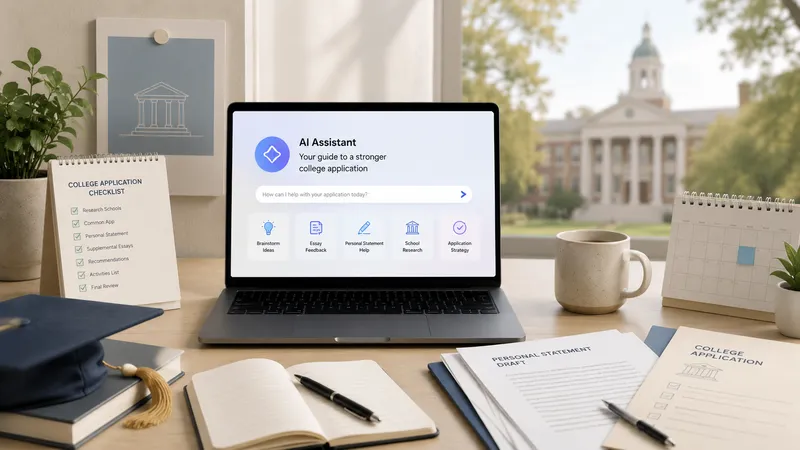
If used correctly, AI can genuinely strengthen your college application essay without having a negative impact on your authentic voice. Here’s where is really adds real value:
- Brainstorming topics: You can use AI to generate a list of possible essay angles based on your experience, then pick the one that feels more like you, and not the one that sounds “impressive”.
- Structural feedback: Ask AI to identify where your outline or draft feels too repetitive, unclear, or unorganised, just like how a mentor or a counselor would correct you.
- Grammar and clarity checks: You can use AI to help you with light editing support for spelling, punctuation, grammar, and any awkward phrasing, just like any normal editing tool.
- Research and fact-checking: AI can help you verify details about your course, programme, university, or research areas that you might mention in your essay while explaining “why choose this university”.
- Practising interview responses: Use AI to act as your interviewer and give you a list of questions that is similar to what admissions teams ask in interviews. You can also ask it to generate an outline for your answers that you can then structure with your own words.
One thing to always keep in mind while writing your essay is that although AI supports the process, your essay should be written and owned by you.
What to Avoid Completely

To make sure that you are meeting every expectation of your university, avoid:
- Asking AI tools to generate a full written draft of your personal statement or essays.
- Letting AI create false experiences, achievements, or emotions that you never actually had.
- Submitting AI-polished writing that does not match your tone or level as shown in your transcript, letters of recommendation, or your interview.
- Assuming a lack of formal AI policy means it's safe to submit fully AI-generated content.
If you are unable to explain any sentence asked by the interviewer during your interview, that shows you are too reliant on AI.
Building an Application That’s Actually Yours
If you’re looking to build a personal profile that is unique to you, our guide on what universities actually look for in applicants breaks down the key factors looked upon by admissions committees, what has more weightage and our piece on how a research publication helps students stand out for Ivy League admissions explores one of the most effective ways to show authenticity before you even write your essay.
If you prefer getting personalised guidance on building your application strategy, our Careers Discovery Programme pairs students and parents with expert mentors, education specialists, psychologists, and senior faculty who will give you guidance on career pathways, CV and portfolio optimisation along with a tailored action plan.
Frequently Asked Questions
Is it cheating to use AI for college essays?
It depends on how you use it. Using AI to brainstorm, outline, or get feedback is normally treated like getting help from a mentor. Whereas using AI to write your entire essay is treated as academic dishonesty, and you may risk getting rejected.
Can colleges actually detect AI-written essays?
Many colleges use AI detection software along with human judgment. Experienced admissions officers can catch AI-generated writing because it doesn't match the tone of the rest of the application.
Will using AI get my application rejected?
Using AI in a thoughtful manner, like brainstorming or editing, is unlikely to hurt your application. Submitting an essay that is substantially AI-written, especially at a university or school with strict AI policy, carries real risk of rejection, or in serious cases can rescind an offer.
Do all universities have the same AI policy?
No. Policies vary from strict prohibitions with signed pledges to more flexible guidance permitting AI for brainstorming and editing. Always check the current guidelines for each university you’re applying to.